Visitor Number

Saturday, June 11, 2011

The Steampunk Strongman!

Hello Friends!

I mentioned previously that I would "later" write  about the place of the strongman and physical culture in steampunk.  Well, now is later, and I shall illustrate this most important aspect.  Physical culture not only belongs in steampunk because it was and emerging and popular trend during the mid-to-late 19th century, but because strength and ability are indeed a must for the intrepid adventurer and explorer.

As a quick recap, what is physical culture?  It is the concept of physical education as set in the 19th (and early 20th) century.  Physical culture included many schools of thought and many methods, all ranging from simple posture and breathing to rugged military drills, and everything in between.  The concept of exercise separate from lifestyle, and as a lifestyle came largely from the observation that as affluence grew, so did ill health.  The activities and diets of our struggling selves had kept us relatively strong, and with new, foreign foods becoming more available, and with work being mechanized and eased, people started becoming flabby as a regular trait (something that has continued to today.)  Of course, there were a great many things they did not know, and much we still do not know, so the search for a more precise understanding of the human being continues.

Now, where does this all fit in with steampunk?  Indeed, many places.  Let us look at a few reasons and examples to illustrate this point.  First, in the world of industrial fantasy, you have far more than just clockwork machinery and steam power.  Man power still existed as a necessity.  From the rural countryside, to the boiler rooms in the factories, strength of body was necessary to heave bushels of produce and lug massive wrenches and kettles.  The bodies of the labor class would be made of the very iron they worked on.  And the military class, putting the overly extravagant works to use, would be packing dozens of extra pounds to their bodies in the name of dominance.  The noble class?  They would not be seen as sickly in comparison to their subjects (though, historically, they were every bit as sickly.)  They would take up leisure activity, hunting, boxing and other sport.  All of this demand would lead worthy (and many unworthy) instructors to supply.  The military, lettered expeditioners, and noble sportsmen would be first in line for the uptake of exercise, sport, and combat instruction.  The labor class would be relegated to carnival stuntmen, and market square performers.  This area would be most open to the charlatans taking advantage.  The snake oil salesmen selling opiates, poisons, and placebos as health tonics, the illegitimate strongmen hefting empty bells, and the sweet talking performers selling convenient devices to shape them up in minutes a day!

Perhaps, though, there would be enthusiasts simply seeking a quiet life who would take on one or two students out of some bond or kinship.  Not all instructors belonged to the circus, military, or royal academies.  No, there were certainly the quiet strongmen who put their muscle to use working on the great boilers, and spinning cogs, who aided the farmers in the harvest in exchange for a simple meal.  You see, strength and ability do not require grand display, and there are many who would not seek fame.

If I may continue with this limited listing, there is then my favorite type of strongman, the one of the wild.  The explorer and adventurer.  The great traveling hunter, archaeologist, geologist, or even reporter.  Those who traveled the world through personal riches, jobs and commissions, and even military charters understood the need for a fit body.  One could simply not hunt in the jungles of Africa, investigate the Central American native ruins, and dig the Gobi Desert without a modicum of fitness.  Many of these men (and women) would be up on their boxing and wrestling, be accustomed to hefting weighted loads of gear and supplies, long treks through uncivilized routes, running from predators, chasing down prey, etc.  It was a life to be reckoned with, and those who survived were as cast of marble as the ancient Greek statues.  Those well-enough-to-do would carry membership to known academies, while the lucky peasantry would be forged from a life of labor.  There would certainly be dabbling in foreign cultural practices, such as those of India and China under the Crown, or of the Native Americans, and immigrant infusion in the Union, and on the frontier.  A wonderful real world example of this is Georges Hebert, a French Navy-man, who saw native Africans escaping from a natural disaster, once gave this quote:

Their bodies were splendid, flexible, nimble, skillful, enduring, resistant and yet they had no other tutor in gymnastics but their lives in nature.

Combining the gymnastic practices of the day with a regimen of moves based on the necessities of survival, he created the Natural Method, the prime tenet of which is:


The final goal of physical education is to make strong beings. In the purely physical sense, the Natural Method promotes the qualities of organic resistance, muscularity and speed, towards being able to walk, run, jump, move on all fours, to climb, to keep balance, to throw, lift, defend yourself and to swim.

In the "virile" or energetic sense, the system consists in having sufficient energy, willpower, courage, coolness, and firmness.

In the moral sense, education, by elevating the emotions, directs or maintains the moral drive in a useful and beneficial way.

The true Natural Method, in its broadest sense, must be considered as the result of these three particular forces; it is a physical, virile and moral synthesis. It resides not only in the muscles and the breath, but above all in the "energy" which is used, the will which directs it and the feeling which guides it.

This lineage survives today through military practices world wide, and the popular parkour movement.  This kind of strength and training would be most greatly employed by the intrepid explorer, either by rote, or by instinct and lifestyle.  His life might be made simpler by auto rifles, steam chariots, clockwork investigative lenses, but his body would be old fashioned sinew and bone.  A strength belied by his frame, and an ability unmatched by the noble savants.  This the the realm in which I play, and live.  I employ the wild strength of the mountain and forest, and of the trained hands and feet.  What is your strength?  Are you the quiet doctor who performs his daily routine upon waking, or perhaps of the gentry studying at the academies?  Do you belong to the carnival or circus, or perhaps just a laboring hand earning his way through work?  Please, tell me your strength, leave a comment, and join the discussion.  Good Journey.


Wednesday, June 8, 2011

Trousers or Pants?

Hello Friends!

I was once told, "Men wear trousers, women wear pants!"  Certainly, I had to check the veracity of that statement, and these are my findings:

Trousers is a 16th century word derived from a combination of the word "trews" and "drawers".  Of course, you know what drawers are.  It is simply a term denoting leggings that are drawn up.  However, I needed to dig a bit deeper to find out what trews were.  The word is derived the Scottish "triubhas", or French "trebus".  Triubhas, or trews, are close fitting tartan trousers, especially worn by select Scottish regiments.

Now, what about pants?  Pants has a simpler story.  Pants is short for pantaloons, which is in turn a French derivative of the Venetian "Pantaleone", a name of a favored Venetian saint from the fourth century.  So what does that have to do with clothing?  Venetians were known for popularizing a style of close fitting leggings, and so the clothing became synonymous with them.  Interestingly enough, the term "pants" became popular (along with the style) in the middle 19th century. 

What remains is the question, "Are pants for women?"  Well, in a word, no.  There is no gender role assigned to either term.  Of course, in proper Victorian, or 19th century American society, the grand majority of women would be wearing dresses, and be expected to wear dresses.  The lines drawn against the sexes were certainly far stricter than today.

We are not, however, living in Victorian England, nor on the frontier.  In fact, the majority of us are just seeking the flavor of the era to set in our fantasy.  Then there are those like me who are looking to develop a lifestyle largely based in the principles of the steampunk genre.  In steampunk, it is simple to find a woman wearing a pant suit as a business owner, or trendy woman on the town, however, this does not in any way delineate the terms.  No, The choice is yours.  Are you a stickler for the old ways, a pastoral laborer?  Trousers is yours.  Are you trendy and cosmopolitan, like a Victorian Londoner?  You'd be wearing pants.  Of course, there are other terms (breeches/britches, knickers, slacks...) but this article is about that one debate which fired my mind for a time.  Me?  I prefer trousers, as I have no need for Venetians hugging my ass.  Good Journey.

Sunday, June 5, 2011

Steampunk Bra?

Hello Dear Friends!

Today's lesson is a bit of fun, and a subject close to my heart (and closer to womens' hearts!)  In the world of steampunk we see the corset over and over again.  It has become quite the fashion accessory, in much the way we expose mechanical works, the corset has been exposed and styled to overtly display the fantasy of the genre.  While the Victorian society was prudish and tight on the surface, steampunk is incredibly sexy, optimizing the ratio between vintage fashion and modern visual appeal.  However, a fact many don't know is that the modern brassiere has an ancestor dating back to the 19th century (and further).

Since time immemorial, women have attempted to support, restrain, and shape their bosoms.  Cloth wrapping and rib mounted under support were the standard for centuries.  Here is the west, both in Europe and North America, the corset became the method of choice, often attributed to Catherine de' Medici--though this is reportedly without support.  The female figure has been a linchpin of fashionable society, and since artificial augmentation is always simpler than cultivating a strong, shapely body (nevermind the incomplete knowledge of physiology...) they chose to tightly wrap and minimize the waist, and emphasize the bust and hips.  However, there were many women who simply couldn't bear the discomfort, and a few of them actually did something about it.

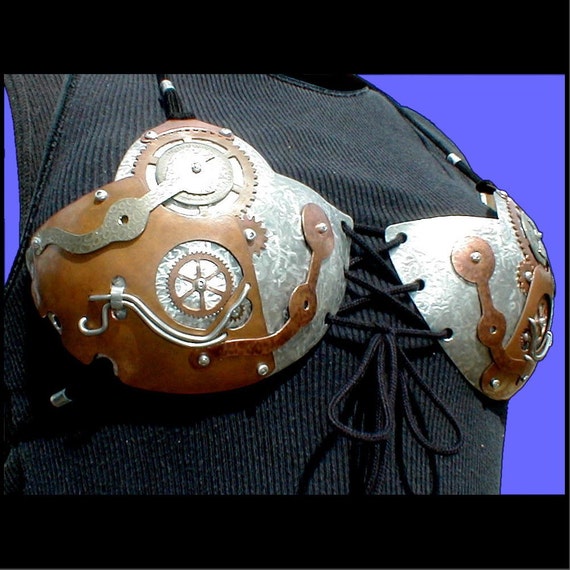
                           A "steampunk" art bra for sale at http://www.etsy.com/listing/26933708/steampunk-metal-bra-series-002-all-sizes

Skipping past some of the earlier advances and departures from traditional corsetry, appearing through the middle 19th century in response to health and comfort concerns (yes, proper corsets caused severe health problems!  It is never a good idea to restrict internal dynamics; including breathing and intestinal function) and we will move straight to Herminie Cadolle in 1889.  The French innovator took her patented design of a separate waist corset and bust support, called the "corselet gorge" (later to be known as le bien-ĂȘtre--''the well-being'') to the Great Exhibition of 1889.  Shortly after the turn of the century, the top half was being sold separately under the still-used-in-France-but-who-cares-because-they're-French (@_@;;;) name "soutien-gorge".  Madame Cadolle's company is still in business today.

In the United States, circa 1893, a woman by the name of Marie Tucek patented something a bit more closely resembling a modern bra.  It pocketed each breast separately, and had a metal plate underneath (a precursor to underwire) and was shoulder strap supported with hook-and-eye closure.  Unfortunately, her business model never developed properly, and her peers and successors have left her but a shadow in history.

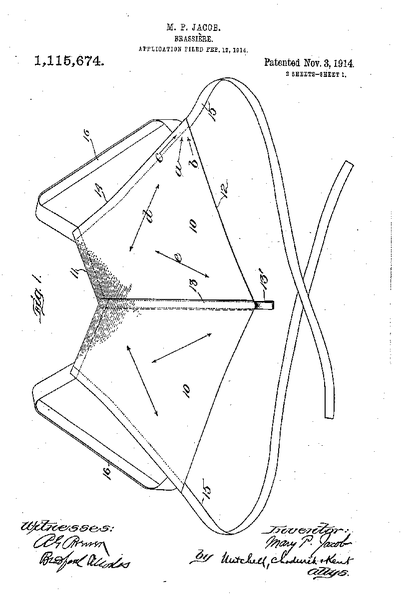
Shortly before the Great War, Mary Phelps Jacob was awarded a patent for the first brassiere recognizable by today's standards.  As the story goes, she needed a better undergarment than the obtrusive corset for an evening gown she was wearing, and so she fashioned together two handkerchiefs and some ribbon, and the idea grew from there.  Her design was a smash hit that she went into business with, but soon found support to be below sustainable levels.  She eventually sold the patent, and her successors and their competitors have since turned the bra into a multi-billion-dollar-a-year business.

                                                       The patent design of Mary Phelps Jacob's brassiere

So there you have it, folks.  A brief history of the brassiere.  There is certainly more to learn, and a book to help you in that venture is "Hoorah for the Bra: A Perky Peek at the History oftheBrassiere". You can, of course, scour the internet for all the information you could ever want as well.  Go on an academic adventure, you will certainly come out of it a bit more knowledgeable.  For a cache of steampunk/Victorian fashion for your own collection, you can always head on over to the steampunk fashon hub at http://steampunkfashion.moonfruit.com/#/clothing/4535346515.  Folks, the sky is the limit.  Go as far as your airship can take you.  Never be restrained by the norms, but innovate, invent, and explore.  Keep your fashion close to your heart, deep within your bosom.  Whatever you choose, make it yours, and make it steampunk!  Good journey.

Thursday, June 2, 2011

First Fiction!

Hello Dear Friends!


I have been granted an opportunity to share with you some original steampunk fiction!  This will be an ongoing, periodically updated story, the duration and outcome of which only the author knows.  So, without further ado, I proudly present to you the first installment of "The Whistlock" by Phillip Roberts.


"The Whistlock"
This:
Meet The Admiral
      Ah! The open skies. Never has there been such a feeling of freedom as when you first set foot upon your ship... Your ship, not any ship, mind you! Your ship with your crew and your commission! And this particular vessel which I have the pleasure of calling my ship is named The Whistlock.
      I have been on ships most of my life, covering every job imaginable. During my first stint in a military force I was on The Cloudburster, where I worked my way up from Small Armsman to Chief Gunner. When hired by the gaudy merchant ship Goldwings, I was first an Assistant Logsman, and eventually a Navigator's Secondly. I later was hired into the crew of Fartrekker, a terrible ship, as a Turnsman -- I made my way to Engineer's Secondly on that blasted vessel, on which surviving may be my greatest accomplishment. Some time later, I came across The Whistlock.
      I managed to make off with it when a ship I was working on, The Tinbear, was brutally shot down. I needed a ship to make good my escape, so with what remained of The Tinbear's bloodied and battered crew members, we overthrew the guards and skeleton crew of The Whistlock. We were ultimately successful in our capturing of the vessel, and in securing further means for our escape. The Whistlock did, however, sustain particularly heavy damage in the process, and I've been paying for it in no small way ever since.
      As I have not yet introduced myself, and yet you already know so much about my history, I feel it is inconsequential to be just now giving you my name. I suppose you will learn it if you need it, and I suppose that you won't if you do not. For the time being, it is enough to know I am ranked not as a Captain, but as Admiral. The reason for that, as with my name, is something you will either figure out or come across, but it is not truly an important issue at this junction of time. What
is important is that I have my own ship manned by an extremely talented and capable crew.
      The acquisition of my ship cost more than a dozen rich and poor souls, and more than a few kegs of explosives, but The Whistlock has this year alone made open more horizons than any full fleet has in the past decade. This is no small feat, as you will come to find out just how difficult it is to keep afloat a vessel that is not properly endorsed by any one company or military force. Still, our adventures are rich, as are their spoils! So long as the skies hold their mysteries, I will be able to maintain this pace.
      "Admiral! The crushpod jammed, causing the leakbarrel to back-up and now the powder-sift is emptying! The estimate is 83% chance against making land to our destination in time to safely set down."
      I have just been informed by Engineer Tillett that my last assumption was incorrect. Fuel is no longer being processed, and we are unlikely to make land at our destination in time for repairs, which will indeed make our pace difficult to maintain. Landing in the waters below and manually powering our naval propulsion engines is the only sensible option. However...
      "If we land within these waters, Admiral, we are certain to be attacked by the Caleuche." My navigator, Jarvis, took the thoughts from my mind and the words from my mouth before either were fully formed.
"Well, Jarvis, just how large of an attack would we be expecting?" Jarvis is the finest navigator I have ever come across. I have come to realize that if it is between the grid lines of a map, he knows all there is to know about the area. Still, he's an odd one, to no short end!
      "Admiral, this area is noted for heavy aggression and a high disappearance rate, as applied up to entire fleets. It may well be that this is a military point of interest for the Caleuche. I would strongly urge we do whatever we must to remain afloat. There is a mountain town 98 miles from here at 96.12-ac/153.66-eq."
"Jarvis, isn't that Christone? When I first brought it up as a point to resupply when plotting our original route, you yourself said that they are not the type to help strangers! You attested that we'd be fired upon as soon as we were within range..."
      "But, sir!..." Jarvis said, cutting into my speech. He did not often attempt to interrupt others. However, to that end, I was not one to often allow others to interrupt myself.
      "...
and," I continued, "that's if we can even make it there! We've handled the Aquarats before, we can do it again." I finished the statement with an assuring nod. It is quite true that it would indeed not be the first time we've had to hold off the Caleuche forces while making an emergency water landing for repairs. Ah, repairs! I suppose I should see how long we will be holding the enemy off, at that. "Engineer Tiller!"
      "Yes, Admiral," Tiller said dutifully as he straightened his stance a bit.
      "If we land in the waters below, how long would it take your team of engineers to get us up and running?"
      Jarvis attempted to say something, but Tiller hurried his statement first, and with a slightly elevated volume. "No more than two hours, Admiral," he assured me.
      I smiled at this. "Excellent! We've held sieges off far longer, and without casualty. Make word to your team th--..." and then I was interrupted,
again!
     "
Admiral," Jarvis shouted, "you don't understand! We will be overwhelmed within mere seconds of touching down! I beg you to take our chances at Christone! By blood and thunder, if worse comes to worse, we can barrage their town and requisition what we need for our own use!" He finished his statement with the look of a man pleading for his life, which was not something which was normally in his character.
      The mention of such a superior force was a bit worrying, but not enough to dissuade me. What
was a shock, and put my mind at a bit of distress, was his recommendation to invade a civilian (albeit personally militarized) mining town. Jarvis was not one to cause local unrest where civilian towns were considered.
      In the past, Jarvis has actively plotted us through combat zones of Caleuche sky-controlled territory. In the end, we turned up richer for the looting, but that was not his intent on plotting us through the hostile zones. It was later revealed the route was planned just to avoid disrupting a string of small mining communities. He defended his decision by stating that our appearance would cause civil disputes for them should we be seen flying too close to any one town. Instead of risking political dispute with the area, his recommendation caused us to engage in bloody warfare with the Caleuche's sky patrols.
      And yet here we are, Jarvis trying desperately to avoid a fight, even at the cost of murder, piracy, and a small-scale invasion of an innocent mining community... Could it really be that the waters beneath us were that terrifyingly bad? I was suddenly given over to the idea of listening to my navigator.
      "Right. Tiller, can we make it the next hundred miles to Christone?"
     Tiller looked agitated, but nodded in a stubborn, reluctant way. "It's possible, but I'll be putting the engineering crew at risk to do so. The machinery is extremely volatile and very dangerous to operate manually while in its current state. I would highly recommend against this course of action, Admiral."
    Jarvis turned to him. "Engineer Tiller, it is either that, or we will all be wiped out. Not just put at risk, but
exterminated. I think you all fail to grasp the severity of where we have found ourselves." He wiped the sweat off of his cold forehead.
     I threw my arms up and grinned at the seriousness of this occasion. "Nope! Got it: land and die; fly and live. Engineer Tiller, I have the fullest confidence in you and your team's capabilities. Mr. Jarvis, accompany Engineer Tiller and help him accurately adjust our manual propulsion systems to get us to our destination as quickly as possible. On your way, now! I will fetch Mr. Tobman and ready our communications array to signal Christone for a peaceful arrival. Failing that approach, I'll alert Mr. Gadbi to prepare for the possibility of the coming assault."
      Ah, what fun and excitement the open skies do hold!
Next: The Invasion of Christone


My Time on the Mountain

April 21, 2011, my wing chun sifu committed suicide.  It was a painful day, followed by more painful days.  There was a great cloud of sadness and depression over me for a time.  You see, I had, to the day, one week prior, been tested and advanced to the chum kiu level of wing chun.  Sifu conducted my test.  I was on top of the world, learning a new martial art, making progress, and making friends, including sifu.  Then it ended, so abruptly, so violently.  The following week I decided to practice my siu lim tao form and techniques at the normally scheduled class time, and then go hike up Camelback Mountain.  I decided to make it a progressive timed challenge (of which I made a 5 minute temporal improvement over the course of a month.)  I found it inspiring, purifying, and just what I needed.  Next week, on June the seventh, 2011, wing chun classes will start up again with sifu's wife (a skilled and capable wing chun sifu herself) and some of the senior students will take over teaching duties.  I will, of course, not cease to go to the mountain, my peace, and my stimulation, but I will have to change my schedule to accommodate the trip every week.  So I've come to this juncture, and I decide to tell you a bit of a personal story about my time on the mountain.

I had been to the mountain once before, made a three hour tour of it, going off trail, taking rest breaks, photos, and just generally enjoying the time.  Since I was a child, I've loved mountains, but never spent much time in and on them.  After relocating to Arizona in 2009, it took me more than a year to make my way to one of the many mountains here.  Camelback Mountain is perhaps the most famous mountain in the Metro-Phoenix area.  On that first trip, I decided that I would be coming back.  It was such a joy and adventure.  Then the events of April 21 occurred, and the decision to make another visit was at hand.
An interesting formation from part way up the mountain, with more mountains in the distance.

Wearing my wing chun school t-shirt, and my beat up old sneakers, I began up the mountain.  It was slow going at first, catching my stride and my wind, but once the trail devolved into stone and boulder, I'd found my pace, and my high.  You see, the extra oxygen and adrenaline heightens your system, and as a side effect, heightens your mood.  Forty minutes after entrance, I reached the summit.  I was worn, but as I looked out over my city at dusk, I was happy.  I found a flat spot, and performed siu lim tao in remembrance of sifu one time.  It felt good.  I pounded down a protein bar, and a pint of water, and jaunted back down the mountain.
A view of my city from the summit.  Yes, there are more mountains on the horizon!

This pattern continued for more than a month, with one week off for a trip to Vegas (another blog, another time.)  In the midst, I found I needed better shoes, and purchased a new pair of hikers, and they have served me well.  Rocks and gravel (yes, there is plenty of loose earth along the path) make for difficult footing without tread, and I slipped, non-hazardously, several times.  After the first week, I began timing myself.  With an initial time of 40 minutes for the 1.2 mile trek, I conditioned myself enough over the course of a month and more to a 35 minute summit.  There were a couple of weeks I even summited an extra day, just because I yearned for the adventure.  One night, I didn't summit at all because an old friend called me on my way there, and I just took a side trail to a big boulder, and once I hung up, I practiced some wing chun atop a great stone.  It was certainly a refreshing night.  I even found myself summiting on the night of "The Rapture" and as I looked out at my city at dusk, I said, "Who needs a rapture when we have this?"  You see, folks, I do not need heaven, I need life, adventure, and experience.  After all, isn't that what the steampunk lifestyle is about?  Innovation and exploration?  There may not be much left to discover, not much need to plant a flag, but there are personal journeys, discoveries, and adventures to be had.  Every place, every day holds the possibility of adventure.  I urge you, be that curious Victorian or frontiersman, get out and explore your world!
Looking over my city from Camelback summit at dusk, the very evening of "The Rapture"

Tonight, June 2nd, I made my way up the mountain.  My final trek in lieu of wing chun class (remember, I'll not cease the journey, just reschedule.)  Upon summit, I saw something peculiar.  I noticed a man sitting atop a rock, reading from a leather bound tome with a seemingly captive audience.  I decided to disengage my personal music, and listen in.  What I found was that I had adventured my way to a wedding.  A pair of fellow adventurers had decided to make the grand life commitment atop the mountain, atop my mountain, in my city.  I was nearly moved to tears, for I am surely a romantic soul.  It was so wondrous, and so beautiful to see a couple in love sharing one of life's most singular moments in such a grand place, and such a grand way.  I audited the ceremony, and once completed I felt the need to applaud and congratulate.  Folks, the newly married Casey and Ashley Phillips, joined by the minister David Joaquim, are such a lovely couple, and a couple I am indebted to meet.  They allowed me to give them special mention here, in front of all of you, and asked nothing in return.
Casey and Ashley Phillips, joined in union by the minister David Joaquim

To them I give the greatest of my wishes.  And so fitting an end to my wing chun mountain journey.  I began when a minister ended it all, and ended when a minister helped a couple to a brand new beginning.  Indeed, every chapter closes to a new beginning.  Good journey.

Wednesday, June 1, 2011

Game Review: Storm Winds

Ever wonder where the steampunk games are?  There are many games out there that have elements of steampunk in them, whether it be Victorian-esque villages and dress, or crazy contraptions somehow incredibly advanced for their outdated tech, but games that are truly steampunk are hard to find.  Where's the intrigue, the industry, and the adventure?  Well, I'll tell you, there's a little flash game called Storm Winds that is quite expressly steampunk in look, feel, and action.  With a focus on the military and tech side of steampunk, it is a fun, free strategy/shooter game that will keep you entertained for a time.  Take a gander, and play for a moment.  It'll cost you nothing but a few moments of idle time, and in this enlightened era you surely have a few moments of idle time.  Good Journey.

The Age of the Strongman

Finally, in these fledgling days of this journal, I get to the subject of my truest expertise:  Physical Culture.  This post will, indeed, be little more than an introduction to an idea.  Back in 2004 I was certified as a personal trainer.  Up until that point, I had learned exercise from my father first, and from school, books, and magazines second.  I always had a desire to have a strong body, but my trek into the world of martial arts made it a necessity.  By the time I graduated high school I had decided to pursue physical knowledge to supplement my martial arts, and perhaps make way for a career.  I formally studied exercise science for a couple of years, leading up to my testing and certification as a personal trainer.  Circumstances being what they were, it was a wasted opportunity for several years, especially since I wasn't nearly as enterprising as I could have, or should have been.  Enter Matt Furey.

Matt Furey introduced me to the concept of physical culture.  It was because of his newsletter, and later purchased programs, that I began to understand that there was more to fitness than strength and a beach body.  Since that time, more than half a decade ago, I have gained immeasurable resources and knowledge.  But the question remains, what is physical culture?

Physical culture is the over arching concept of health and fitness during the 19th century.  This was the age of the professional strongman.  At a time of budding scientific curiosity and understanding, the edifiers of physical culture drew upon long standing military, athletic, and labor traditions.  There was a recognition that life made easy by technology seemed to necessarily reduce peoples' physiques, vitality, and health.  Looking back in retrospect, we can certainly say that affluence has its price, and exercise for the sake of exercise becomes necessary when life is easy.  Of course, they got as many things wrong as they got right, but health and exercise are an area readily tested, and over the course of a few short months people can say whether or not something is working for them.  This was also a time of charlatans and sideshow entertainment, and the carnival strongmen were certainly not always honest with the veracity of their feats.  However, without this age of free trial and error, and carnival popularity, we may not have expanded in knowledge of the human body so rapidly.

I've rambled on quite enough at this point, and I would like to leave you a couple of old names is physical culture that I believe are well worth their salt, and paved the way for greater physical understanding.

Eugen Sandow
Alexander Zass
Martin "Farmer" Burns
Georges Hebert

These names should give you a good preliminary search, as you wait for my more expansive articles to arrive.  How will this fit into your steampunk cosplay or lifestyle?  I'll tell you later.  Good journey.